What Ingredient List Order Can Tell You About Cosmetics
Ingredient list order can hint at a cosmetic’s base and help you compare formulas, while showing why placement alone cannot prove strength, suitability or results.
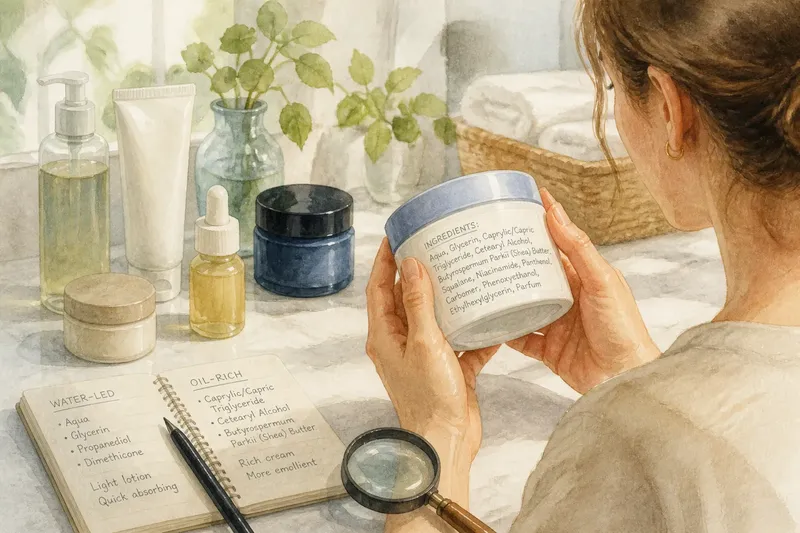
Ingredient list order can hint at a cosmetic’s base, but it cannot tell you on its own whether the product will suit your skin or perform well. The opening names often reveal more about the formula’s structure than its benefits: a familiar ingredient near the bottom may still have a role, while one near the top may simply form the base.
Use the list to build a rough picture, then check the product’s stated purpose, directions and any ingredients relevant to your own preferences. The rules behind the order matter, too.
What does ingredient list order usually tell you?
In the United States, cosmetic ingredients are generally listed in descending order of predominance, with an exception for ingredients present at one per cent or less, which may be listed in any order after those present at higher concentrations. Colour additives have separate ordering rules. Other markets have their own labelling requirements, so do not assume the same convention applies to every product.
Where the applicable rules place ingredients in descending order, the first names often describe the formula’s main building blocks: water, oils, emollients, solvents or other materials that give a product its texture and help it spread. That opening sequence is useful for recognising a broad formula type, not for predicting exactly how it will feel.
A water-led moisturiser and an oil-rich balm may begin with different ingredients because their structures differ. Neither arrangement declares one better; it tells you something about the formula’s composition under the relevant labelling convention.
Read the first few names as a sketch of the formula’s foundation, not as a scorecard.
Why can the lower part of a list be hard to rank?
Under US cosmetic labelling rules, ingredients at concentrations of one per cent or less may be listed in any order after ingredients above that level. This means you cannot confidently compare the relative amounts of every ingredient near the end just by checking which name comes first.
A recognisable botanical extract, vitamin or fragrance component near the bottom may be present at a low level, but its exact amount and role are not revealed by its position. A low-listed ingredient is not automatically irrelevant: some ingredients serve a purpose without making up much of a formula.
Ingredient names can also refer to blends or complex materials. A plant extract, for instance, may arrive in a carrier that is separately named on the label. The list declares ingredients; it is not a complete recipe showing how every supplied material breaks down in the finished product.
What can the first few ingredients reveal?
The opening entries can help you identify a product’s broad composition. Water near the start suggests a water-based phase; oils, waxes or other lipid ingredients near the start may point to a richer format. These are clues about structure, not promises about finish or results.
Ingredient families offer more context than a single name. Humectants such as glycerin can help attract and hold water; emollients can soften the feel of skin; surfactants help cleanse or disperse materials; and thickeners help create consistency. Their roles depend on the full formula, so avoid assigning a product’s behaviour to one ingredient in isolation.
Say you are comparing two face creams: one starts with water and glycerin, while the other starts with oils and waxes. Those openings give you a reason to expect different formula structures and to check each product’s stated use and texture description. They do not tell you which cream will suit your skin better.
Use the opening ingredients to ask what kind of formula you are looking at; use the rest of the label for context.
Can placement tell you how strong an active ingredient is?
Not reliably. A name’s position does not supply an exact concentration, and a label may not disclose one. Even an ingredient near the top does not show whether its amount, form or combination with other ingredients is appropriate for a particular purpose.
Ingredient identity matters as well. A label may use a technical or standardised name rather than the everyday term used in advertising, and related forms are not automatically interchangeable. If you want to identify a particular active, match its full listed name and check the product directions rather than relying on a familiar marketing word.
Claims about a product’s intended role can add context, but they do not turn ingredient order into a potency scale. If you have a skin condition, a history of reactions or uncertainty about using a product, follow its directions and ask a qualified professional for advice.
Does a higher position mean an ingredient works better?
No. Ingredient order reflects quantity only within the limits of the applicable labelling rules; it does not rank effectiveness, quality or suitability. A common base ingredient may appear near the top because it makes up much of the formula, while an ingredient with a narrower function may appear lower.
Performance depends on more than amount. An ingredient’s form, the overall composition, how the product is applied and how it is stored can all affect the experience. The list cannot show every formulation detail or predict how a particular person will respond.
Do not treat “higher” as inherently desirable. A product is not automatically superior because a fashionable ingredient appears near the beginning, just as it is not automatically ineffective because that ingredient appears near the end.
What can the list tell you about fragrance and sensitivities?
The list can help you spot ingredients you already know you prefer to avoid, including fragrance-related ingredients when they are declared individually. Depending on the applicable rules, fragrance may also appear under a collective term. This can help narrow choices when you are comparing products with similar uses.
A label cannot predict your personal reaction. A product described as fragrance-free may still contain ingredients with a scent of their own, while a fragranced product is not necessarily a problem for every user. If you have a known allergy or persistent skin concern, ask a qualified professional for advice and follow the product directions.
A short list is not automatically gentler, and a long list is not automatically harsher. The identities of the ingredients and your own history matter more than the count.
How should you compare two ingredient lists?
Compare products with the same intended use, then look for meaningful differences rather than counting names. Each check below links an observation to a decision and an alternative action.
- Check the product type: if both labels describe the same kind of product, compare their ingredients; if not, choose a like-for-like product before drawing conclusions.
- Check the first few names: if they suggest a base you want to consider, read further; if the base does not suit your preferences, set that product aside and compare another.
- Check for a specific ingredient by its full listed name: if it appears, review its role and the directions; if it does not, check the manufacturer’s product information rather than assuming a marketing term is equivalent.
- Check for fragrance or another ingredient relevant to your preferences: if it is listed and you prefer to avoid it, choose an alternative; if the label is unclear, contact the manufacturer.
- Check the directions and cautions: if they fit your intended use, keep the product under consideration; if they do not, follow a product with suitable directions instead.
- Check the label’s regional context: if you know which market’s rules apply, interpret order accordingly; if you do not, consult the manufacturer’s information rather than assuming a universal rule.
Imagine you are choosing between two rinse-off cleansers. For this invented example, cleanser A lists water, glycerin and surfactants near the start; cleanser B begins with a different blend of cleansing ingredients. You first confirm both are rinse-off cleansers, then check each full list for a fragrance ingredient you already prefer to avoid and read the directions. If A has no listed ingredient you are avoiding and its directions fit your intended use, you keep it on your shortlist; if B includes that ingredient, you set B aside or ask its manufacturer about an unclear label. The result is a more informed shortlist, not certainty about comfort or performance before use.
What questions do readers ask about ingredient order?
Can I tell the exact concentration from the list?
Usually not. Ingredient order offers a relative clue within the applicable rules, but the label does not normally give an exact concentration for every ingredient.
Does a late-listed ingredient do nothing?
No. Its position may suggest a low amount, but that does not establish that it has no role. The ingredient’s purpose and the full formula matter.
Does the first ingredient define the product’s performance?
No. The first ingredient can indicate a major part of the base, but performance depends on the formula as a whole, directions and individual response.
Can ingredient order tell me whether a product is right for my skin?
Not by itself. Use the list to check for ingredients relevant to your preferences or known sensitivities, and seek qualified advice when a skin condition or allergy makes the choice uncertain.
How should you use ingredient list order?
Treat ingredient list order as a map with a deliberately limited scale. It can orient you to a formula’s broad structure, flag ingredients you want to investigate and help you compare like with like. It cannot reveal a full recipe, quantify every component or forecast your individual experience.
Pair the list with the product’s stated purpose, directions and packaging information. If the label leaves a question unanswered, check the manufacturer’s product information rather than filling the gap with assumptions about placement.
The most useful habit is to let ingredient order shape your next question, then look for the information that can answer it.