Reading a Beauty Claim Before You Buy
Reading a beauty claim before you buy helps separate specific product details from persuasive promises, so you can judge whether the label suits your needs.
Reading a beauty claim before you buy is easier when you separate what a product literally says from what its packaging wants you to imagine. A label might pair “lightweight daily moisturiser” with “restores your natural glow”; the first phrase describes a product and a use, while the second leaves the promised result open to interpretation.
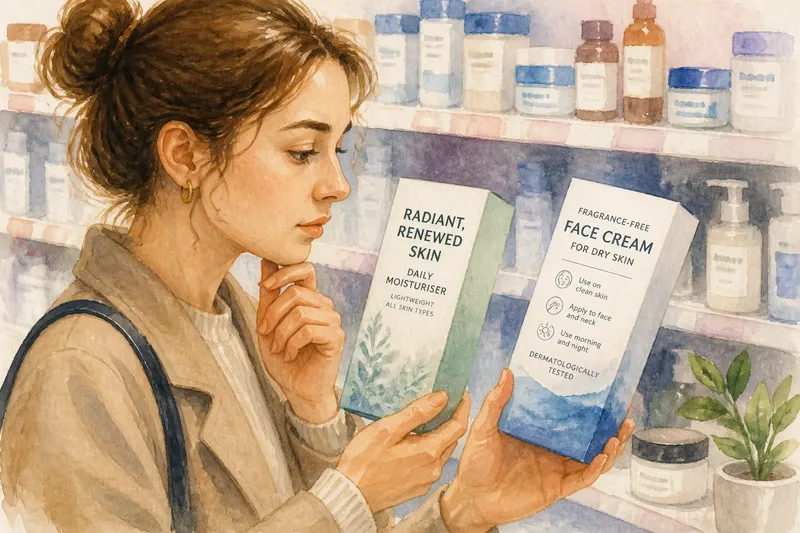
Say you are choosing between two moisturisers on a pharmacy shelf. One carton promises “radiant, renewed skin”; the other says “fragrance-free face cream for dry skin” and lists how to use it. This is an invented situation, not a report of a real purchase. The useful question is not which label sounds more impressive, but which one gives you information you can act on.
What does the claim actually say?
Start by finding the shortest plain-language description: what the item is, where it is meant to go, and what sort of use the brand proposes. These details may appear on the front, sides, or back rather than together in one neat sentence.
In the imagined shop, “face cream” identifies the product, “for dry skin” names its intended audience, and “use on clean skin” gives a direction. Those are concrete clues. “Radiant” and “renewed” may suggest a desirable look or feeling, but they do not specify what visible change to expect or how to assess it.
Underline the nouns and verbs in your mind: cream, face, apply, soothe. Then set aside the emotional adjectives for a moment. This small pause helps prevent a colourful phrase from being mistaken for a product feature.
Which words describe a feature, and which sell a feeling?
Promotional language often works by association. “Silky”, “fresh” and “luminous” can evoke texture or appearance, but without further detail they may describe a sensory impression rather than a defined outcome. That does not make them meaningless; it means they answer a different question from “What does this product do?”
Look for words that can be understood in more than one way. “Gentle” might refer to a brand’s positioning, while “for sensitive skin” identifies an intended user group without telling you how your own skin will respond. “Clean” can refer to a brand’s chosen standard, but the word alone does not tell you which ingredients or rules are involved.
In the hypothetical choice, the carton’s “renewed skin” phrase does not tell you whether it means softer-feeling skin, a changed appearance, or simply a fresh impression. The second moisturiser’s audience and use are clearer, though they still do not promise a personal result.
What can the packaging support?
Turn the carton around and compare the headline with the details. Check the product type, intended area, directions, warnings, and any explanation attached to the claim. If the packaging names a feature, look for a plain account of what that feature means rather than assuming the headline supplies the whole story.
For example, “fragrance-free” is a specific product description. “Clinically inspired” is broader: by itself, it does not explain what was assessed, how, or what conclusion the brand is asking you to draw. If a claim points to a particular standard, the packaging should make that standard understandable enough for you to decide whether it matters.
For claims tied to a particular definition, rely on the product label, the manufacturer’s explanation, and applicable local rules; these can differ. You do not need to settle every technical question at the shelf. You do need enough clarity to avoid treating a slogan as evidence of a result.
How do you tell whether a claim fits your decision?
Ask what decision you are making. If you need a face cream for dry skin, product type and intended use may help more than a promise of radiance. If you are avoiding fragrance, a direct fragrance description matters more than a phrase such as “fresh feel”. The relevant claim depends on the reason you are shopping.
Imagine you want a moisturiser that feels comfortable under make-up. The package says “weightless finish” but gives no further detail. You could treat that phrase as a clue about the brand’s intended sensory impression, then look for directions or a sample option if available, rather than assuming every user will experience the same finish.
That imagined shopper might choose the clearer carton because it identifies a face cream for dry skin and gives use directions. The result is not proof that it will suit them; it is a more informed choice based on what the packaging actually communicates. If the important detail remains unclear, setting the product aside is a reasonable decision.
Which questions help decode beauty claims?
Does “dermatologist tested” tell me how my skin will react?
No. The phrase does not, on its own, tell you what was assessed or predict your individual response. Treat it as a claim to interpret, not a personal suitability verdict.
Does “natural” mean a product is safer?
Not by itself. The word can be used in different ways and does not explain whether a product suits your needs or sensitivities. Check the full description and relevant label details instead of relying on the reassuring tone.
Is “clinically proven” a clear result?
The words sound definite, but the phrase alone does not tell you what outcome was considered or what the claim means for your choice. Look for a clear explanation of the stated benefit and avoid filling in details that the package does not provide.
What should I do if two claims sound equally vague?
Compare the practical information around them: product type, intended use, directions, and any relevant warnings. If neither label answers the question that brought you to the shelf, consider another product or seek clarification from the brand.
What should you carry from the shelf?
The invented shopper’s useful lesson is simple: separate the product description from the hoped-for feeling, then choose according to the detail that matters to you. “Face cream for dry skin” can guide a comparison; “renewed radiance” may add atmosphere, but it cannot replace a clear description.
Next time, read the front of the pack as an invitation and the rest as context. Reading a beauty claim before you buy does not require cynicism; it asks you to notice which words describe the product, which words suggest an outcome, and where the label leaves room for interpretation.