From Jar to Pump: How Beauty Packaging Changed the Product Experience
Beauty packaging history traces how jars, compacts, tubes and pumps shaped display, portability and daily handling—helping you choose a format that fits your routine.
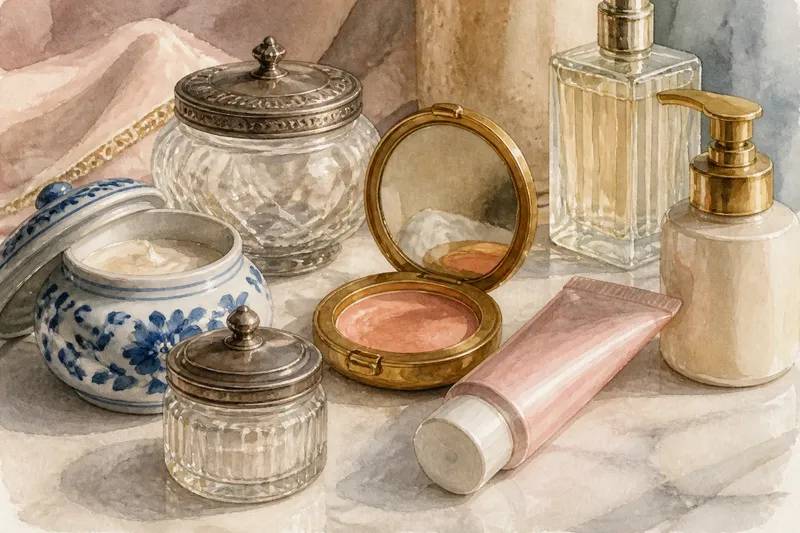
Beauty packaging history is visible in the small actions a container asks of you: twist a lid, lift a compact, squeeze a tube or press a pump. Those choices shape where a product can be stored and how easily it can be handled, without telling you whether the formula itself is suitable.
What do older cosmetic containers tell us?
Surviving historic containers include small pots and jars made from materials such as ceramic, glass and metal. Their forms tell us how a vessel was arranged and opened; by themselves, they cannot establish how common a particular package was across a period or place.
A wide opening makes the contents easy to see and reach, while a lid covers the opening between uses. The container can also be part of a dressing-table display: decoration draws the eye, while a plain vessel puts function first. Treat these as clues to design and handling, not a complete account of beauty customs.
How did the compact change cosmetic packaging?
A compact gathers a product and its case into a flat, portable object. Some designs also bring a mirror and applicator together, so a user can check and apply cosmetics away from a dressing table.
That arrangement makes the case itself part of the experience. Its hinge and clasp hold the parts together, while its finish can make a functional object feel like an accessory. A compact format is not suitable for every kind of product; the case must accommodate its contents.
What does a tube or pump change?
A tube lets the user squeeze product through a narrow opening and replace its cap. A pump uses a press-and-dispense action instead. Both alter the way a person reaches the contents, but neither format alone reveals what is in the formula or how well it will suit someone.
These packages also create practical differences. A cap can be simpler than a mechanism, while a pump has moving parts that may not work smoothly with every product. Labels and manufacturer directions are the best guide to using a particular container.
How can you compare packaging without judging the formula?
Compare what you can observe: the opening, closure, dispensing action, visibility of the contents and ease of handling in the place you plan to use it. A polished finish may look appealing, but it is not evidence of formula quality or suitability.
- Check the opening: if it is wide enough for the intended access, then it may be easy to reach; if it is awkward or exposes more than you want to handle, consider a different package.
- Check the closure: if the lid or cap stays securely in place during ordinary handling, then it may suit storage; if it feels loose, choose a package with a closure that feels more secure.
- Check the dispensing action: if a pump or squeeze opening releases product as intended, then the action may suit your routine; if it sticks or is difficult to control, consider another format.
- Check portability: if the package closes fully and fits the place you intend to carry it, then it may be convenient on the move; if it is bulky or difficult to secure, keep it in a fixed spot or choose a more portable option.
- Check visibility: if seeing the contents helps you handle the package, then a visible container may be useful; if appearance matters less than covered storage, choose an opaque option instead.
- Check the instructions: if the label gives clear directions for the package, follow them; if the mechanism is unclear, consult the manufacturer rather than forcing it.
Which packaging questions do shoppers ask?
Does a jar or a pump make a product better?
Neither format establishes formula quality. A jar provides a broad opening, while a pump offers a press-and-dispense action; the useful choice depends on handling and the manufacturer’s instructions.
Are compacts only used for powder?
Compacts are closely associated with products held in a flat case, often alongside a mirror. Other contents may use compact-style packaging, but the particular case and directions determine how it should be handled.
Why might a product come in a tube?
A tube offers squeeze dispensing through an opening that can be covered with a cap. It changes access and portability; it does not, on its own, indicate the product’s ingredients or quality.
Does an expensive-looking package mean a better formula?
No. Materials and decoration influence presentation, but they do not prove a formula is effective or suitable for you. Check the product information and consider the package’s handling instead.
How do you choose packaging for a real routine?
Say you have a hand cream in a wide jar on your bathroom shelf and want to carry it in a gym bag. You inspect the jar’s lid and find that it closes securely, but its broad shape takes up awkward space beside your other belongings. You compare it with a capped tube of the same cream: the tube fits the pocket you plan to use and lets you dispense without setting down a separate lid. The trade-off is that the tube’s narrow opening may feel less convenient at home, so you keep the jar by the sink and carry the tube when portability matters. These are invented, hypothetical package details, not claims about a real product.
For a quick decision, tie each visible feature to an action:
- If the package will stay on a shelf and its lid is easy to remove, then a jar may work; if reaching into it is inconvenient, consider a tube or pump.
- If you need a product and mirror together, then a compact may suit the task; if you do not need a mirror, a simpler case may be preferable.
- If squeezing gives you manageable access, then a tube may fit; if the opening is hard to control, look for another dispensing format.
- If a pump works smoothly and the product directions permit its use, then it may suit a fixed counter; if it sticks or does not dispense, follow the label and contact the manufacturer if needed.
Beauty packaging history is most useful when it helps you notice what a container actually asks you to do. Read the label for directions, then choose the opening, closure and format that make sense in the place you will use the product.